 Understanding Dyslexia
Some useful analogies
As the parent of a dyslexic son or daughter, you may find it hard to understand how they feel, what dyslexia is like and what you need to do to help. These analogies may help you to understand some of the important aspects of dyslexia.
“This booklet provides eminently practical advice for both dyslexics, their parents and their teachers.”
Why analogies?
I use analogies and stories in much of my teaching. They are a good way of explaining ideas, and they often conjure up a picture that is more memorable than words alone.
Used at the right time, some of these analogies can help children, as well as parents, to understand the difficulties they may be experiencing.
Jane Mitchell
The analogies
Read them in order, or choose one to go straight to it.
 Dyslexia and computers
 IQ and fast cars
 Dyslexia and disabilities
 Attitude and rain
 Lessons and film production
 Practice and sport
 Planning lessons and choosing a holiday
 Teaching and eating
 The seven intelligences and Trivial Pursuit
 Memory and computers
 Short-term memory and fuses
 Recalling and filing
 Conclusion and roadworks
Dyslexia and computers
Imagine you get a beautiful new computer for Christmas.
It has a huge hard drive, lots of games in the box, speakers and a colour printer.
But when you have set it up, it doesn’t work as you had hoped. The software is for an Apple Mac and you have a Windows PC, and the printer can’t print your work because the right printer driver is missing.
There is nothing wrong with the computer. It has a good memory, an excellent processor and all the internal workings it needs. The problem is with the input, because of the Mac software, and with the output, because of the printer driver.
This is a bit like being dyslexic. The input your child receives may not match their own way of working. Some subjects, at school or at home, will be presented in a language or system that suits them, and so will get into their brain (the computer). Other subjects don’t even get in. It is like hearing somebody talk to you in a language you can’t understand.
It is the same with output. A dyslexic child or student may have all the ideas and knowledge in their head, but be unable, like the computer, to print them out and get them down on paper.
Back to all the analogiesIQ and fast cars
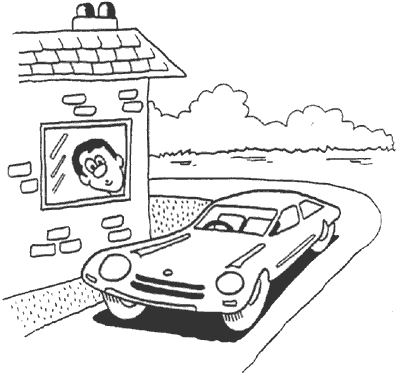
Imagine you have a beautiful, fast new car on your driveway at home, but you don’t know how to drive it.
Once you start driving lessons, you can progress through the various skills and techniques, mastering corners and roundabouts, until you can drive safely on your own.
Many dyslexic children have been assessed and told they have a high IQ, and yet they feel confused. If a child is doing badly at school and knows they aren’t getting the same good marks as their friends, they may not be convinced of the value of a high IQ.
A high IQ may be like the fast car that you have not yet learned to drive.
A specially trained teacher can help your child learn to use their IQ to its full advantage.
Back to all the analogiesDyslexia and disabilities
Dyslexia is hidden. People can’t tell that your child is dyslexic just by looking at them.
This can be an advantage. No one in the street will stare and point at your son or daughter, as people sometimes do with other disabilities. But it also means your child’s dyslexia may have gone undiagnosed for many years. As a parent, you may not have realised that your child was having problems, or what was causing some of their difficulties.
People have many hidden differences. Some are thought of as disabilities; others simply close certain doors. Colour blindness can stand in the way if your child wants to be a pilot, and coeliac disease can stop a young person joining the army. A poor short-term memory, poor handwriting, slow reading and weak spelling can make some careers harder for your dyslexic child. But dyslexia is not an automatic bar, in the way colour blindness can be.
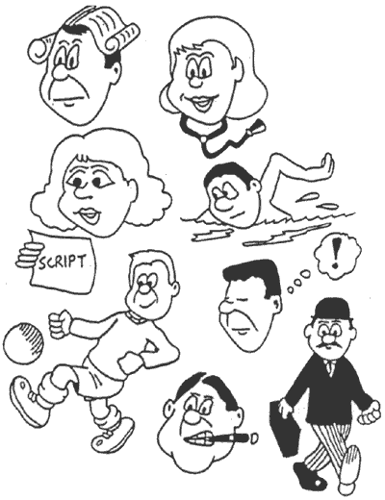
Dyslexic people include:
- doctors
- lawyers
- actors
- swimmers
- footballers
- memory champions
- business people
- entrepreneurs
Success depends on many things, and as parents you can encourage helpful attitudes in your child:
- to do their best
- not to give up
- to keep trying, whatever the setbacks and difficulties
- to be determined to find answers
- to achieve their goals
- or even to prove wrong the people who think they can’t learn.
Attitude and rain
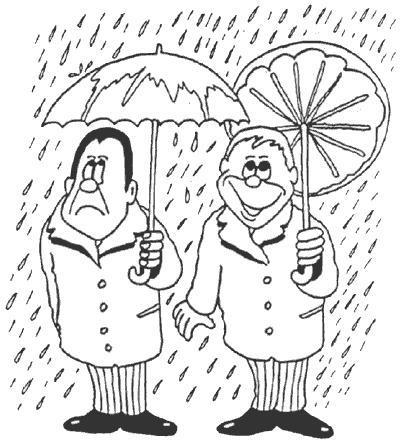
When it rains, some people are happy and others are sad.
It depends not on the rain but on their attitude to it. Some think of the disadvantages and say, “I can’t go out.” Others think of the advantages and say, “The garden needs the rain.”
In my view, the reaction to a diagnosis of dyslexia is similar. The attitude both you and your child take can determine future success or failure. Attitude can be changed more easily than dyslexia. The change may happen overnight, or it may take years.
Many dyslexic teenagers say that being dyslexic has made them think about things that come automatically to others. They have thought about:
- their motivation
- how they learn best
- where they study best
- how they can remember better
- the importance of organisation
- how their feelings about certain teachers affect their learning.
Many students never need to consider these things, because learning has come easily to them. With the right guidance, a dyslexic student who finds study difficult may start to develop sensible attitudes and strategies that help to ease their problems.
Back to all the analogiesLessons and film production
A driving instructor can only teach you to drive a car.
They won’t teach you to build a car, mend it when it breaks down or advise you on the best insurance. There is a whole range of skills that can be taught to dyslexic children. But one teacher cannot usually do everything.
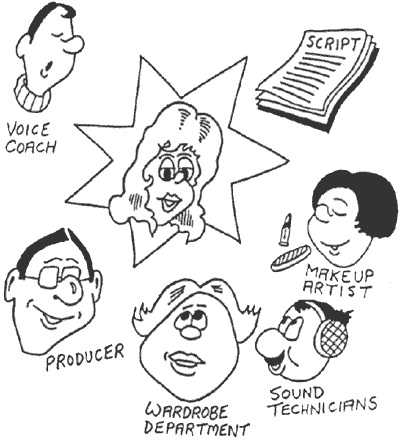
When a film is being made, the star needs the help of many people, including:
- scriptwriter
- make-up artist
- sound technician
- wardrobe department
- producer
- voice coach
In the same way, your dyslexic son or daughter may need lessons or advice from:
- educational psychologist
- special needs teacher
- assistive technology specialist
- optometrist
- schools placement adviser
- learning support teacher
- speech and language therapist
- study skills specialist
- counsellor
- handwriting specialist
- dyslexia teacher
- occupational therapist
- kinesiologist
Depending on their age and needs, your child will need different kinds of help.
Back to all the analogiesPractice and sport
However many specialists you take your child to see, it won’t help unless their advice is followed.
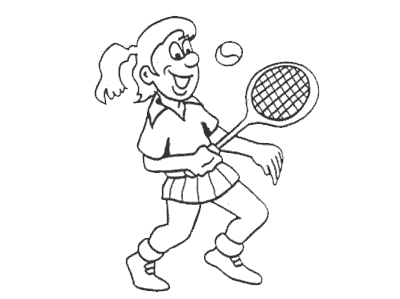
Even when a teacher has shown your child what to do, they can’t expect to improve without practising, just as in sport.
With practice, you can always progress at a sport, for example through the belts in judo or the championships in tennis. In the same way, with practice, your dyslexic son or daughter can progress through a range of levels as they get older.
Back to all the analogiesPlanning lessons and choosing a holiday
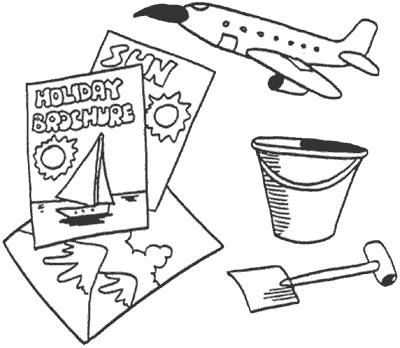
Deciding how to help your dyslexic child is like looking through holiday brochures before you book a holiday.
If you know what is available, you can choose and save up for it.
Some flights get booked up very early. Similarly, many teachers and educational psychologists are booked up weeks or even months ahead. It is essential to plan in advance the help your child may need.
Find out what schooling and help are available. As well as asking schools, look at resources such as the British Dyslexia Association, and contact local dyslexia associations, dyslexia teaching centres or educational psychologists.
Back to all the analogiesTeaching and eating
In a restaurant, you would expect a choice of food to satisfy your hunger.
There is no single food that suits all people, all nationalities or all tastes. I believe the same is true of teaching methods for your dyslexic child. Dyslexic children are not all the same, although they may have similar difficulties. The underlying causes may be different, and each child’s interests and experiences will certainly be different.
Each person has their own way of learning, so a teacher should offer a variety of methods for teaching spelling and literacy skills. The question should not be “Which is the best method: phonics, look-and-say or real books?” but “Which method, or combination of methods, suits this child?”
We are all advised to give our children a healthy diet, balancing each child’s dietary needs and preferences. In the same way, an experienced teacher would not use only one teaching method, but would balance the methods they use.
Back to all the analogiesThe seven intelligences and Trivial Pursuit
With luck, a person can get round the Trivial Pursuit board, and even win, answering questions only on their favourite topic.
Similarly, some people have successful careers in sport or music, whatever their knowledge of literature or geography.
Howard Gardner, of Harvard University, describes seven intelligences:
- Linguistic
- Mathematical
- Visual and spatial
- Kinaesthetic
- Musical
- Interpersonal
- Intrapersonal
He later added an eighth, the naturalist intelligence.
At school, children sometimes feel as if the dice are heavily loaded towards the first two. But in the outside world, if your child can keep their confidence and self-esteem, the other intelligences are useful and valued. Musicians, sports people, craftspeople and those who care for others are all essential members of our society.
Back to all the analogiesMemory and computers
There are several types of memory.
Short-term memory can hold pictures or sounds, and is useful for storing information for a short while. But unless information is transferred from short-term to long-term memory, it is lost after a few seconds. It is like typing on a computer: unless you save your work, it is lost as soon as the computer is turned off.
Long-term memory is the equivalent of the computer’s hard drive. It holds pictures, words, feelings, experiences, knowledge of everyday actions, and meanings and spellings. Items stored in long-term memory are secure; they can’t simply be wiped. This information is normally stored safely, although, just as a power surge or a virus can damage a computer’s files, a stroke or meningitis may affect what is held in long-term memory.
Being able to remember something for a short time doesn’t mean it will be remembered in future, or that it has been transferred to long-term memory.
Dyslexic children may seem to know some information, or be able to repeat a spelling or read a word just after being told it, but this only tests their short-term memory. It doesn’t prove that the information has reached their long-term memory. For many dyslexic children, it is necessary to actively transfer information from their short-term memory to their long-term memory.
Back to all the analogiesShort-term memory and fuses
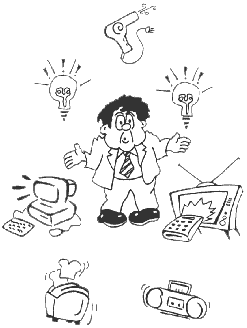
If you overload an electric circuit by running too many heaters, lights or large appliances, the fuse will blow (or, in a newer home, the trip switch will cut out).
Short-term or working memory is like this. If a dyslexic child puts one item too many into their memory, all the items may be forgotten.
A child needs to find out what their memory can cope with, and take in information in chunks of the right size, to prevent overload and “fusing”.
Back to all the analogiesRecalling and filing
Information saved on a computer is secure, but that doesn’t mean you can find it.
There may be files that aren’t clearly named, or that are confusing. You may have USB sticks with no labels, and it could take hours to search through each one to find the letter or document you need.
It is similar for dyslexic children. They may have stored information, vocabulary or spellings, but not have filed them somewhere easy to reach. The time it takes them to search for a word may mean they forget what they were looking for, or the moment passes and everyone else is talking about something different.
A more traditional analogy is trying to find a book in a library that has no classification system, where the books are arranged randomly on the shelves. The search can take a long time and be very frustrating.
Dyslexic children can be taught to label and organise the information they store and, like a library, to have a good classification system that saves time and effort.
Back to all the analogiesConclusion and roadworks
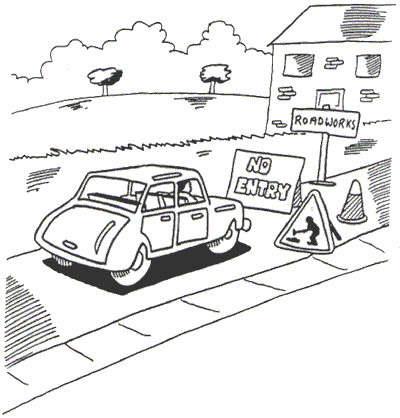
If you came across roadworks on a journey, you probably wouldn’t turn back, go home and decide not to go out until they were cleared.
You would be more likely to find another route to where you were going.
Children with dyslexia meet many difficulties on their journey, and must be encouraged not to give up. Parents can play a big part in helping their child to find alternative routes and methods to reach their goals.
Back to all the analogiesDownload the booklet
The Understanding Dyslexia analogies booklet is free to download and print.
Download the booklet (PDF)Using and sharing the booklet
The booklet is free to download, but it remains the copyright of CALSC, the Communication and Learning Skills Centre.
- You may photocopy the downloaded pages for private, non-commercial use, as long as the CALSC details are not deleted or blanked out.
- If you share part or all of the booklet with your pupils or students, please credit the author, Jane Mitchell.
- You may not include any of this material in other publications, whether they are given away or sold, without written permission from Jane Mitchell at CALSC.
To ask for permission, phone 01797 361318 (from outside the UK, +44 1797 361318).
About this booklet
Understanding Dyslexia was written by Jane Mitchell and first published in 1996 by the Communication and Learning Skills Centre (CALSC). Jane later made it free to download, so that people could print it for themselves.
Reviewing it for the British Dyslexia Association’s magazine, Dyslexia Contact, Brother Matthew Sasse wrote that although it was written for parents, it would help classroom teachers and dyslexic people themselves just as much. He praised how familiar the analogies are, which quickly puts readers at ease with the subject, and the simple, humorous illustrations. Above all, he valued its positive and constructive approach: rather than dwelling on problems, it points parents towards practical ways forward.
He also noted the ground it covers: disabilities and differences, attitudes to dyslexia, specialist help, practice and success, planning ahead, choosing a teaching method, short-term and long-term memory, and accessing information.
© 1995–2026 Jane Mitchell, Communication and Learning Skills Centre (CALSC)