Classi-cards
C-cards for classifying, comparing and categorising
Classification skills are a prerequisite for many activities in the curriculum. Many underlying skills such as thinking, memory, organisation, note-taking and word retrieval also depend on an ability to compare and categorise efficiently. All these are skills needed for efficient learning to take place.
C-cards
C-cards have therefore been developed to improve the student’s skill at classifying and characterising objects and seeing patterns, links and hierarchical relationships between them. Many different exercises can be played with the C-cards. They can be used by parents, teachers or therapists who can vary the exercises to suit the needs of the child or student.
C-cards consist of three sets of cards:
- Primary Classi-cards – 180 cards for younger children
- Classi-cards – 135 cards for older children and adults
- Compa-cards – sixty pairs of pictures to compare
- A guide to using C-cards – covers all three sets
There are sufficient numbers of cards to teach the strategies of memory, organisation and thinking. The aim is not to teach every semantic link possible but to teach the principles which the child can generalise into their vocabulary.
All the C-cards have word sets which match the pictures and can be used for reading activities.
Playing games with the C-cards makes learning fun whilst developing important skills.
The cards are easy to photocopy and allow the teacher total flexibility to use them as they wish.
Also they can be given to parents to help with their child’s homework or follow up to encourage generalisation in the home (unlike many expensive resources).
Primary Classi-cards
Primary Classi-cards can be used with younger children. They can be cut up into 180 individual cards, or can be used as complete pages in games such as lotto. They are arranged in fourteen semantic fields:
- Transport
- Animals
- Music
- School
- Food
- Meal time
- Party time
- The House
- Furniture
- Bath time
- Bed time
- Toys
- Clothes
- The Garden
The following illustrates an example of how Primary Classi-cards can be used to develop classification and categorisation which leads to improved comprehension and word-finding skills.
The child initially grouped the cards according to numbers of legs and did not naturally use the sub-groups shown below.
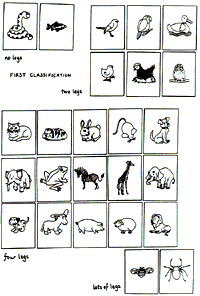
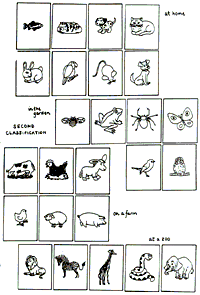
The discussion that accompanied the re-sorting of the Primary Classi-cards helped develop vocabulary and classification.
These skills were practised with several semantic fields and led to improved fluency and reduction in word-finding difficulties.
Classi-cards
Classi-cards are suitable for use with older children and adults. They can be cut up to produce 135 individual cards. In order to sustain the interest and motivation of the students some of the objects are drawn from unusual perspectives. The twelve semantic fields covered by Classi-cards are as follows:
- Transport
- Food
- Office equipment
- Stationery
- Communications
- Household items
- Weather symbols
- Scientific equipment
- Buildings
- Animals
- Sport
- Seasons / celebrations
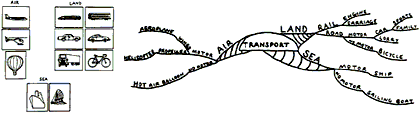
Mind Mapping can be taught using Classi-cards and then the skill transferred to curriculum subjects as illustrated in the guide to using C-cards.
Compa-cards
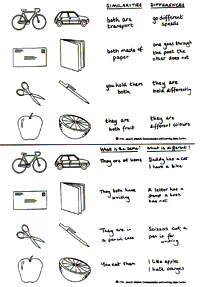
Compa-cards are pre-prepared exercises containing sixty pairs of pictures. These worksheets can aid categorisation and comparison skills. All children need to develop flexibility in thinking and the ability to see similarities and differences between objects or concepts. The aim of Compa-cards is to provide sheets that can be discussed with a child orally or used as a written exercise. The lack of headings and instructions allows each teacher to adapt the sheets to the needs of each child.
This example illustrates how Compa-cards can be used to discuss comparison skills.
It shows that the comparisons made will differ according to the age of the child.
An older child making comparisons that are too basic can be taught to use more complex vocabulary or encouraged to expand their knowledge or thinking about the objects in a variety of ways, as illustrated in the guide to using C-cards.
A guide to using C-cards
A guide to using C-cards covers all three sets of cards and discusses briefly the developmental sequence of classification skills, and the importance of meta-cognitive strategies. It describes some useful exercises to develop comparison and classification skills.
How to order
Classi-cards includes Primary Classi-cards, Classi-cards, Compa-cards and the guide. It is available from CALSC – The Communication and Learning Skills Centre as a course.